
Macular Hole
Has your central vision become blurry or distorted? Are you noticing a dark spot in the center of your sight? You may be experiencing symptoms of a macular hole, a treatable retinal condition that affects the sharp, detailed vision you use daily. At Retina Consultants of Southern Colorado, our fellowship-trained retina specialists have extensive experience diagnosing and treating macular holes with advanced techniques. We're here to help you understand this condition and explore your treatment options with clarity and compassion.
What Is a Macular Hole?
Causes and Risk Factors
Macular holes most commonly affect people over the age of 55, with women experiencing them more frequently than men. The vast majority of cases develop spontaneously without an obvious cause, which means there's currently no proven way to prevent their formation. However, if a macular hole develops in one eye, there is a 5% to 15% risk of one developing in the other eye.
Several conditions can increase the risk of macular hole formation:
- Vitreous traction: As we age, the vitreous gel that fills the inside of the eye naturally shrinks and can pull away from the retina. Sometimes this process creates tension that leads to a macular hole.
- Eye injury or trauma: Blunt trauma to the eye can cause macular holes, particularly in younger individuals.
- Diabetic eye disease: Complications from diabetes can increase risk.
- High myopia (severe nearsightedness): Greater degrees of nearsightedness are associated with increased risk.
- Macular pucker: Scar tissue that forms over the macula can contract and warp the retina, potentially leading to a hole.
- Retinal detachment: Previous or concurrent retinal detachment may be a risk factor.
Importantly, genetics, environmental factors, and most systemic health conditions don't appear to play a significant role in macular hole formation.
Symptoms to Look Out For
The most common symptom of a macular hole is a gradual decline in the central or straight-ahead vision of the affected eye. You may experience:
- Blurred central vision: Difficulty focusing on objects directly in front of you.
- Visual distortion (metamorphopsia): Straight lines appearing wavy, curved, or bent.
- A dark or blank spot in your central vision: This may start small and expand over time.
- Difficulty reading or performing detailed tasks: Activities requiring sharp central vision become increasingly challenging.
The degree to which your vision is affected depends on the size and location of the macular hole, as well as the stage of its development. Symptoms typically develop gradually, though some people may notice changes more suddenly.
How Macular Holes Are Diagnosed
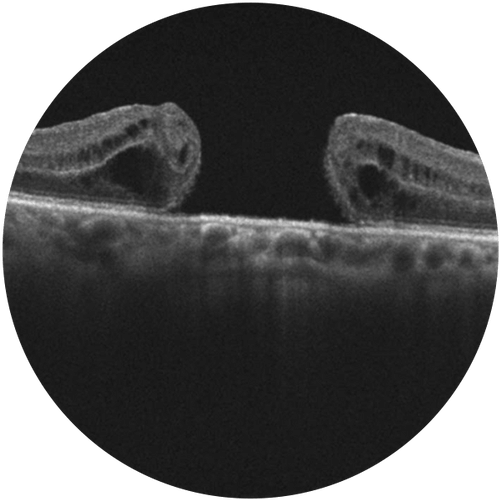
Optical Coherence Tomography (OCT) is the gold standard for diagnosing, staging, and managing macular holes. This quick, non-invasive imaging technique uses reflected light to create high-resolution cross-sectional images of your macula, allowing your doctor to:
- Confirm the presence of a macular hole
- Determine its size and stage
- Differentiate it from other eye conditions with similar symptoms
- Monitor changes over time
For idiopathic macular holes (those without a known cause), no additional laboratory tests are typically needed. Your retina specialist will conduct a comprehensive eye examination along with OCT imaging to develop the most appropriate treatment plan for your specific situation.
Treatment Options
Vitrectomy is the most common and effective treatment for macular holes. During the procedure:
- The vitreous gel is carefully removed to eliminate traction on the retina
- A delicate membrane peel may be performed to remove any remaining tissue pulling on the macula
- A gas bubble is typically placed inside the eye to gently hold the edges of the macular hole closed while it heals
After surgery, you may be asked to maintain a face-down position for several days to up to two weeks, depending on the characteristics of your macular hole. This positioning allows the gas bubble to press against the macula and support healing. The bubble will gradually dissolve over time and be naturally replaced by your eye's own fluids.
During the recovery period, you won't be able to fly or travel to high altitudes, as changes in air pressure can cause the gas bubble to expand.
Recovery, Prognosis, and Why Early Detection Matters
Vitrectomy for macular holes has an excellent success rate, with more than 90% of patients experiencing hole closure and visual improvement. Many patients regain a significant portion of their lost vision, though the degree of recovery varies depending on:
- The size of the macular hole
- How long it was present before treatment
- Individual healing responses
As with any surgical procedure, there are potential risks, including cataract formation (the most common), retinal detachment, infection, glaucoma, bleeding, and re-opening or persistence of the macular hole (occurring in less than 10% of cases). Your surgeon will discuss these risks with you in detail before your treatment begins.
That said, one of the most important factors in achieving a good outcome is timing. Early detection and prompt treatment can greatly improve the chances of preserving and recovering central vision. Left untreated, a macular hole can gradually enlarge and cause more extensive damage to the retina, which may limit visual recovery even if surgery is ultimately successful.
If you're experiencing any changes in your central vision, like blurriness, distortion, or dark spots, don't wait to seek evaluation. Prompt diagnosis and treatment can make a significant difference in your visual outcome.
Advanced Macular Hole Care in Southern Colorado
At Retina Consultants of Southern Colorado, our board-certified retina specialists use state-of-the-art diagnostic technology and proven surgical techniques to treat macular holes with precision and care. We understand how concerning vision changes can be, and we're committed to providing you with clear answers, personalized treatment plans, and compassionate support throughout your journey.
Early intervention offers the best opportunity for preserving and restoring your sight. If you're experiencing symptoms of a macular hole or have concerns about your central vision, contact us today to schedule a comprehensive retinal evaluation.