
Epiretinal Membrane (Macular Pucker)
Have you started to notice floaters or flashes in your eyes? Do you have questions after a recent Epiretinal Membrane (ERM) diagnosis? You're not alone, and Retina Consultants of Southern Colorado is here to provide the specialized retinal care and clear answers you need.
What is an Epiretinal Membrane?
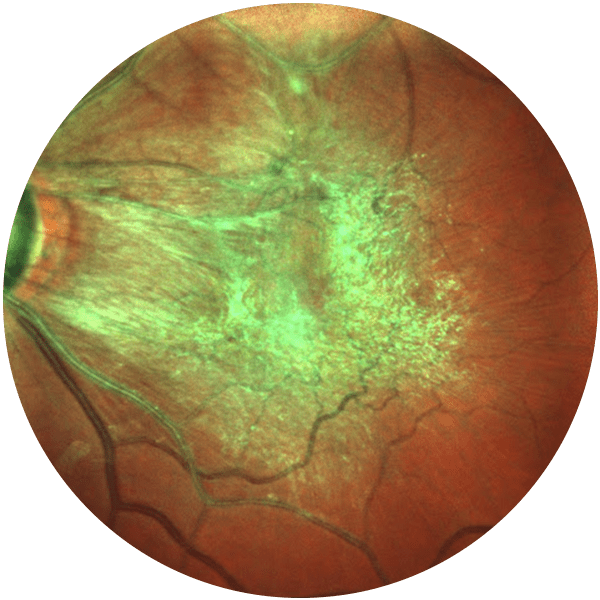
ERMs are mostly harmless and cause minimal symptoms, with many people living with them without ever knowing they're there. However, problems can arise when this cellophane-like layer affects your macula, the central part of your retina responsible for sharp, detailed vision that allows us to distinguish small details and recognize faces. Loss of vision and visual distortion or metamorphopsia are common side effects once this occurs.
What Causes Epiretinal Membranes?
Epiretinal membranes develop when there's a microscopic defect in your retina's surface, allowing certain cells to migrate and multiply, eventually forming a sheet-like membrane over the retinal tissue. Picture this membrane as a piece of cellophane that can gradually wrinkle and contract. As it tightens, it creates friction against the delicate retinal tissue beneath, potentially causing visual distortions where straight lines appear wavy or curved — a condition called metamorphopsia.
The most common cause of ERMs is a natural aging condition called posterior vitreous detachment (PVD). As we age, the gel-like vitreous that fills our eyes begins to shrink and pull away from the retina. This separation often causes those floaters you might notice, but it can also create the small retinal defects that allow ERM formation.
ERMs can also be associated with other ocular conditions, such as prior retinal tears or detachment, retinal vascular diseases like diabetic retinopathy or venous occlusive disease, eye trauma, previous ocular surgery, or inflammation inside the eye.
What Symptoms Should You Watch For?
Many patients experience no symptoms of ERMs, and their ERMs are discovered incidentally during dilated retinal exams or retinal imaging. However, when symptoms do occur, they typically develop gradually and may include:
Early-Stage Symptoms:
- Subtle visual distortion where straight lines appear slightly bent or wavy
- Minor blurriness in central vision
- Difficulty with fine detail work like reading small print
Advanced Symptoms:
- Significant visual distortion (metamorphopsia)
- Noticeable decrease in central vision sharpness
- Problems with depth perception
- Increased difficulty with activities requiring fine visual detail
It's important to note that sudden vision changes, new flashes of light, or a curtain-like shadow in your peripheral vision require immediate medical attention, as these could indicate more serious retinal conditions like retinal detachment. Our providers are here to provide dedicated retina care and get you the answers you need.
How Are ERMs Diagnosed?
An eye care provider can diagnose most ERM cases during a routine clinical exam. And here at Retina Consultants of Southern Colorado, we use state-of-the-art diagnostic technology to provide precise ERM evaluation, including:
-
Comprehensive Retinal Examination: Our specialists begin with a thorough dilated eye exam, using specialized lenses to examine your retina in detail.
-
Optical Coherence Tomography (OCT): This imaging technology creates detailed cross-sectional images of your retina, allowing us to:
- Measure the thickness and extent of the membrane
- Assess any retinal swelling or distortion
- Monitor changes over time
- Plan surgical intervention if needed
-
Fluorescein Angiography: In some cases, we may recommend this specialized test to evaluate blood flow in the retina and rule out other conditions that might complicate treatment.
Treatment Options
For the majority of patients with mild ERMs, careful monitoring is the most appropriate strategy. Many ERMs remain stable for years without causing significant vision problems. During regular follow-up visits, your eye care specialist will track any changes in the membrane's appearance and monitor your visual function.
If your ERM begins to significantly impact your vision or quality of life, surgical intervention may be recommended. Your specialist may suggest a surgical procedure called vitrectomy to remove the membrane and restore clearer vision.
Important Note: Unfortunately, no eye drops, oral medications, or nutritional supplements can treat or prevent ERMs. While this might be disappointing, the good news is that surgical treatment, when appropriate, can be highly effective.
Prognosis and Outlook
Most people diagnosed with ERMs have an excellent long-term outlook. The key factors that influence your prognosis include:
- Severity at diagnosis: Mild ERMs often remain stable
- Location: Membranes away from the central macula cause fewer problems
- Your overall eye health: Other retinal conditions can complicate treatment
- Timing of intervention: Early monitoring and surgical treatment often yield better results
When to See a Retina Specialist
If you're experiencing visual distortion, blurred vision, or have been diagnosed with an epiretinal membrane, early evaluation is crucial. The sooner we can assess your condition, the better we can preserve and potentially improve your vision. Your vision is our priority, and we're here to guide you through every step of your treatment journey.
Advanced Care for Epiretinal Membranes Southern Colorado
Our team of fellowship-trained retinal specialists brings decades of combined experience in diagnosing and treating ERMs. We understand that vision problems can be scary and confusing, which is why we're committed to:
- Clear Communication: We explain your condition in understandable terms
- Advanced Technology: State-of-the-art diagnostic and surgical equipment
- Personalized Care: Treatment plans tailored to your specific needs and lifestyle
- Ongoing Support: Comprehensive follow-up care to monitor your progress
Contact Retina Consultants of Southern Colorado today to schedule your comprehensive retinal evaluation.